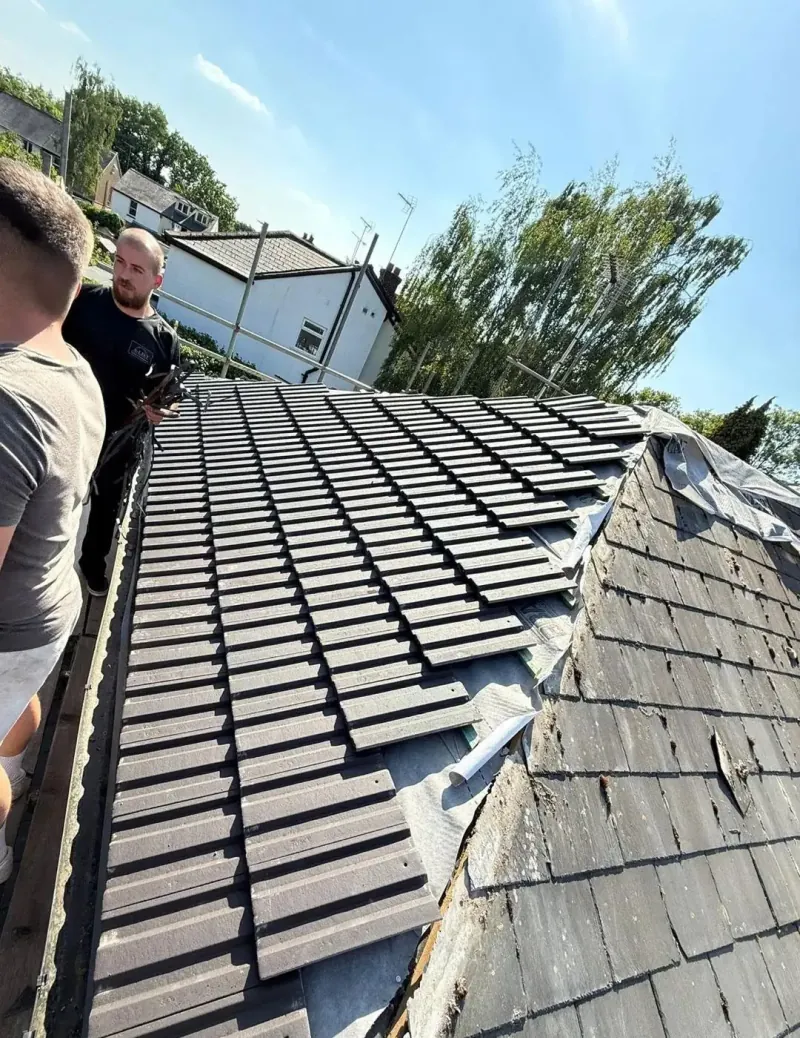
Most roofing problems in Frimley start small. A cracked ridge, one slipped interlocking tile or a failed flashing will let water in long before anything shows on the ceiling below.
We start every repair with a proper inspection rather than an assumption. Water rarely enters where it appears inside, and chasing the stain instead of the cause is how homeowners end up paying for the same job twice. We trace the entry point, photograph it so you can see what we have seen, and then quote for the repair that actually fixes it.
Typical repairs on Frimley properties include re-bedding ridge tiles where the original mortar has finally let go, replacing cracked concrete interlockers, renewing flashings where cement fillets have failed, clearing and re-lining valleys, and repairing the flaunching around chimney stacks.
- Slipped, cracked and missing tiles replaced
- Ridge and hip tiles re-bedded or converted to dry fix
- Failed cement flashings replaced with proper leadwork
- Valley and chimney leaks traced and sealed
- Photographic evidence of the fault before and after
Full Roof Repairs Guide A great many Frimley roofs are now simply out of years. The tiles may look sound from the pavement, but the felt underneath them has been going brittle since the 1960s.
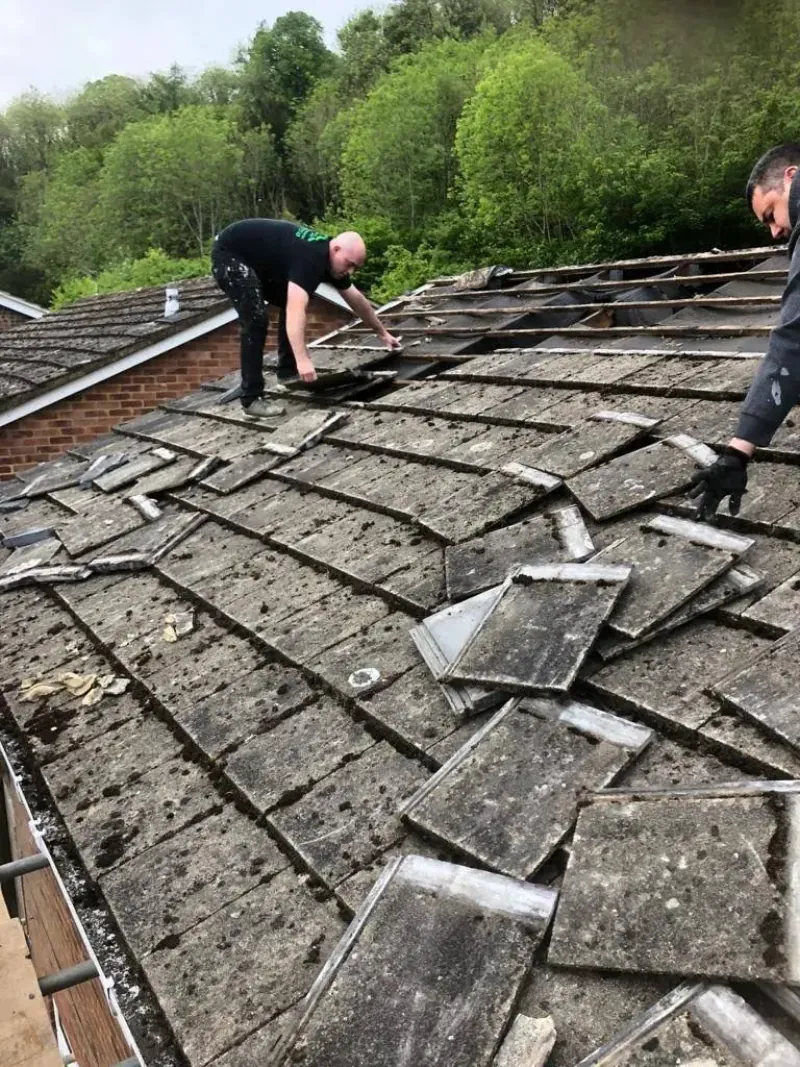
This is the single most common job we do here, and the reason whole streets seem to get re-roofed within a few years of each other. The post-war and 1960s–70s estates around Frimley and Frimley Green went up together under the same interlocking concrete tiles on the same bitumen felt. Once that secondary barrier tears, wind-driven rain gets straight past the tiles and starts wetting battens and rafters.
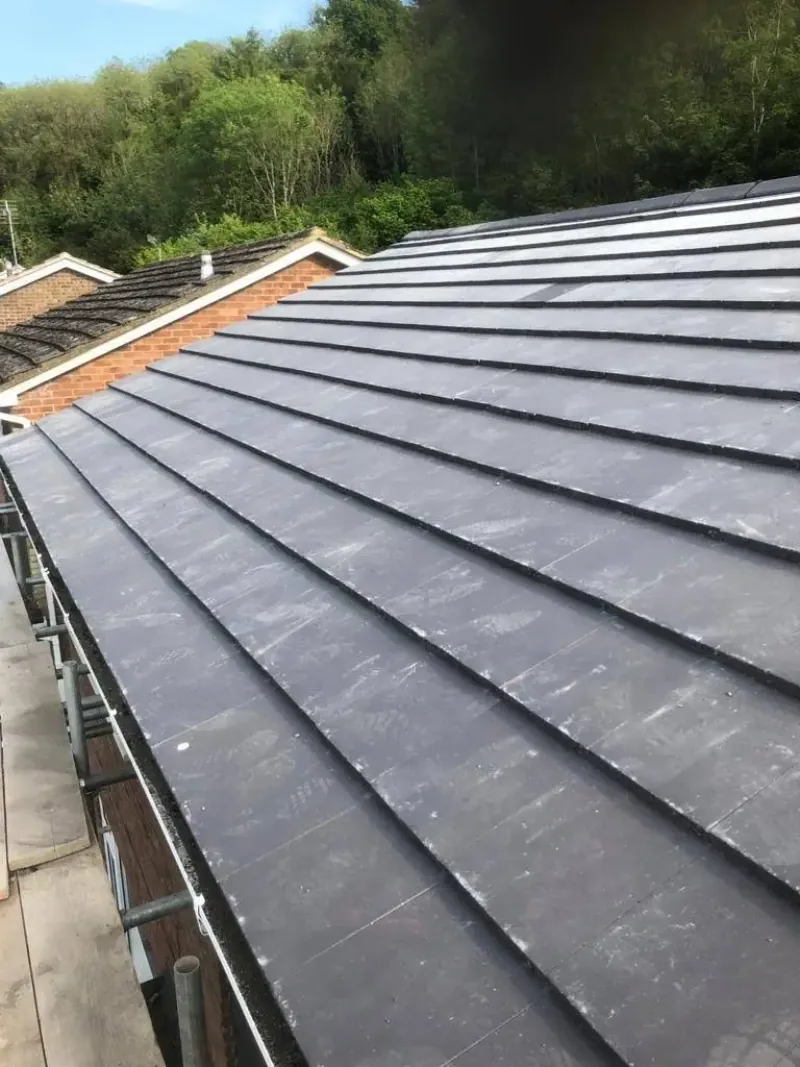
The job itself is methodical rather than dramatic. Everything comes off, the battens and rafters get inspected and repaired where fifty years of damp has taken a toll, then modern breathable membrane goes on, the roof is re-battened, and the covering is laid back with fresh ridge, verge and flashing details throughout. Where the original mortar bedding has been the recurring problem, we fit dry ridge and verge systems instead. Scaffolding, skips and the sweep-up are inside the quoted price.
- Full strip, inspect and re-cover
- Modern breathable underlay for a healthier roof space
- Concrete tile, clay tile or natural slate to suit the property
- Dry ridge and dry verge systems as standard where suitable
- Scaffolding, waste removal and site clean-up included
Full New Roofs Guide Frimley has more flat roofing than most towns its size. The estates here came with detached garages, flat-roofed extensions and dormers as standard, and much of it is still on its original covering.
Two faults account for nearly all of it. Either the original pour-and-roll felt has blistered, gone brittle and split along a lap, or the roof was laid dead flat from the outset so rainwater collects in a shallow pool in the centre and simply waits. Down here in the valley that pool is rarely given the chance to evaporate between one downpour and the next, and standing water will locate any weakness you leave it.
So we start underneath. Soft or spongy decking comes off and is replaced, falls are built back in so water is pushed towards the outlet, and only then does the new covering go down — torch-on felt, single ply, GRP fibreglass or EPDM rubber, whichever suits the roof and the budget. The time then goes into upstands, drip edges and outlets, since a flat roof almost never fails in the open field.
- Torch-on felt, single ply, GRP fibreglass and EPDM rubber
- Correct falls designed in so water reaches the outlet
- Rotten decking replaced before the new covering goes down
- Warm roof build-ups where insulation needs upgrading
- Extensions, dormers, porches, garages and outbuildings
Full Flat Roofs Guide Frimley spans every building era from Victorian cottage to modern estate, and the pitched roofing changes with it — plain clay tiles, natural slate, and a great deal of interlocking concrete.
On the older properties around the High Street we work slate and plain clay tile the traditional way, matching size, colour and gauge so a repair does not stand out like a patch. Nails corrode long before slate does, so slipped slates on an otherwise sound roof are common and very fixable.
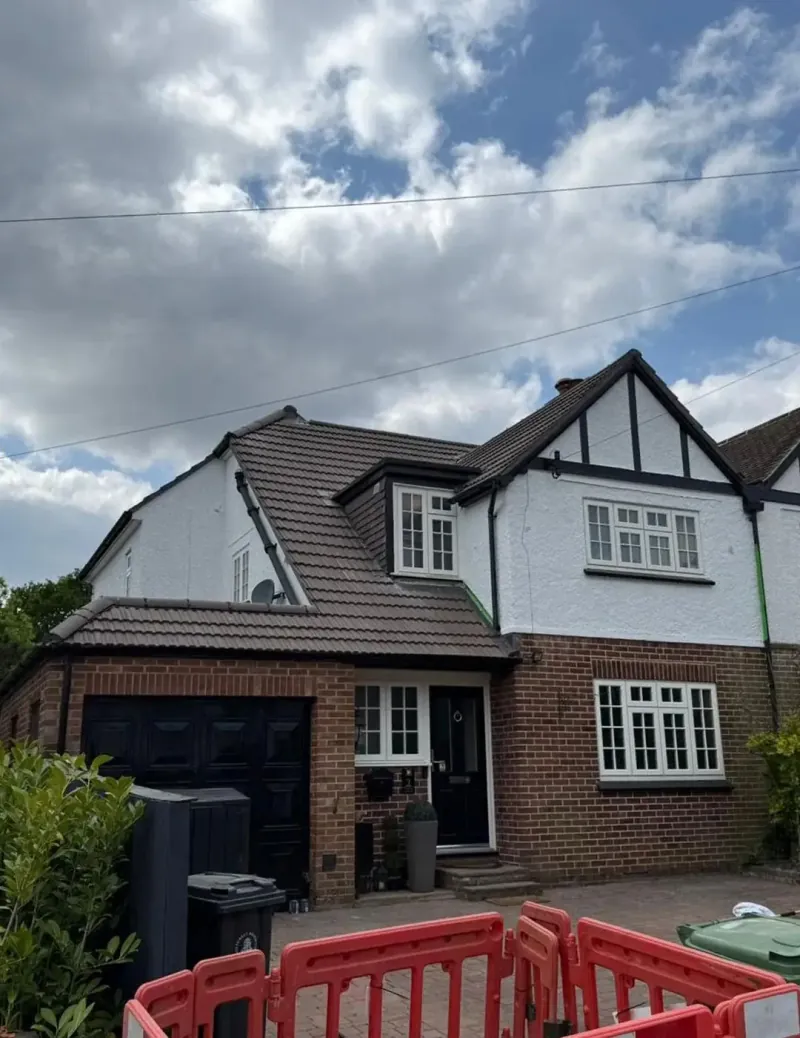
On the estates it is mostly single-lap concrete interlockers, where the weak points are the ridge and verge details that take the brunt of the weather. Where old mortar bedding keeps cracking, we will usually recommend converting to a mechanically fixed dry system rather than re-bedding it again in three years.
- Natural slate and plain clay tile laid traditionally
- Concrete interlocking tiling on estate housing
- Sympathetic material matching on period properties
- Dry ridge and dry verge conversions
- Underlay, battens and timbers checked as part of the work
Torch-on felt remains the most cost-effective covering for the detached and block-built garages that come with almost every Frimley estate house.
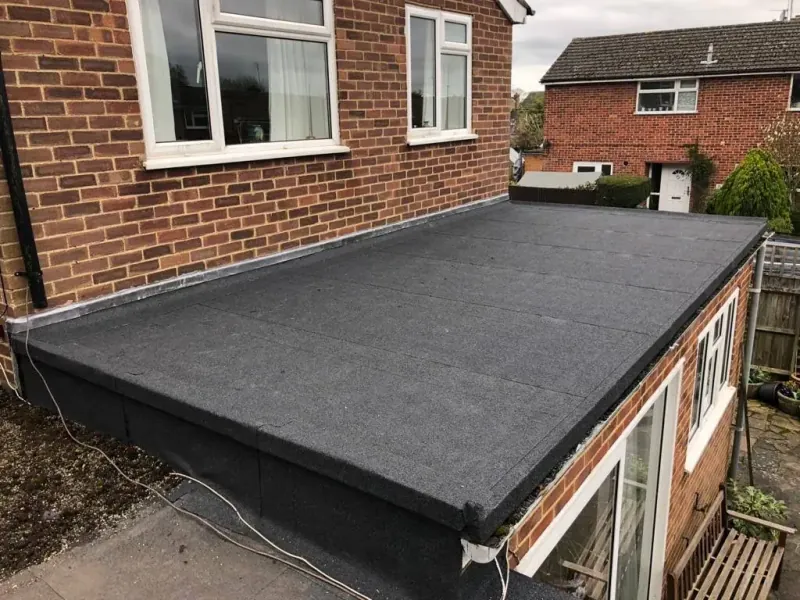
Felt has a poor reputation, and it is undeserved — what it actually has is a long history of being rushed. Laid onto tired decking with lapped joints that were never properly welded, it will fail inside five years. Laid onto a sound, primed deck as a bonded three-layer system, it will quietly do its job for two decades.
The parts nobody sees are the parts that decide it. We trim the edges in metal rather than sealing them with mastic, dress the upstands where the roof meets a wall, and finish in a mineral cap sheet that copes with frost in January and the heat that builds on a south-facing garage roof in July.
- High-performance three-layer torch-on systems
- Decking replaced where it has softened
- Welded laps, metal drip trims and dressed upstands
- Mineral cap sheet finish
- Garages, outbuildings, porches and small extensions
Your roofline does more than tidy up the edge of the roof — it ventilates the loft and carries every drop of rainwater away from the walls.
Once fascia timber softens, the gutter brackets lose their grip and the run starts to sag. Water then spills behind the gutter and down the brickwork instead of into the downpipe, which is how damp patches appear on internal walls with no obvious leak in the roof itself.
On Frimley’s many semis and terraces the gutter run is often continuous across the party wall, so it pays to know where the join falls before starting. We replace fascias, soffits, bargeboards and guttering in maintenance-free uPVC, build in continuous or over-fascia ventilation, and re-run gutters to correct falls.
- Full uPVC roofline replacement in white, black or woodgrain
- Rotten fascia and soffit timber removed, not covered over
- Continuous soffit or over-fascia loft ventilation
- Shared runs on semis and terraces handled sensibly
- Repairs and one-off replacements as well as full runs
Moss is the defining maintenance problem on Frimley roofs. The damp air off the Blackwater Valley and the Basingstoke Canal means it takes hold faster here than a few miles up the hill.
Moss does more damage than most people realise. It holds water against the tiles instead of letting them shed it, which accelerates frost damage over winter, and clumps of it break away and wash straight into the gutters. On a north-facing slope that never really dries out, it can re-establish within a couple of years.
A proper clear means the gutters, the downpipes, the hoppers, the valleys and the flat roof outlets, then water down the run to prove it actually drains rather than assuming it does. The moss comes off the tiles as well, not just out of the gutter it fell into. And because we are already up there with a clear view of the whole roof, you get told about anything else worth knowing — a cracked ridge caught in October costs a fraction of the ceiling it would have ruined by March.
- Gutters, valleys, hoppers and downpipes cleared
- Runs flushed through and checked for correct fall
- Moss removal from tiles and slates
- Debris taken away, not left in the borders
- Free report on anything else we notice up there
Storm damage does not wait for office hours. When a roof fails suddenly, the priority is stopping water getting in — everything else can be sorted out afterwards.
On the estate housing around Frimley the classic winter emergencies are ridge tiles lifted off in a gale, sections of felt peeled back on a garage roof, and water coming through a bedroom ceiling after a tile has gone unnoticed for weeks.
Ring at any hour and someone comes out. The first visit is about safety and water: anything loose enough to fall gets taken down, the damage gets sheeted, and the ingress stops. Nobody attempts a proper repair in the dark in a gale. Once the house is protected we come back in daylight, inspect the whole roof, price the permanent fix in writing, and hand you the photographs and written detail your insurer will want.
- Available 24 hours a day, seven days a week
- Rapid temporary weatherproofing and sheeting
- Loose and dangerous material made safe
- Full photographic record for insurance claims
- Permanent repair quoted in writing afterwards