Cracked Ridge Mortar
The single most common fault on Frimley estate housing. Original bedding gives up after decades of thermal movement and lets water straight in at the apex.

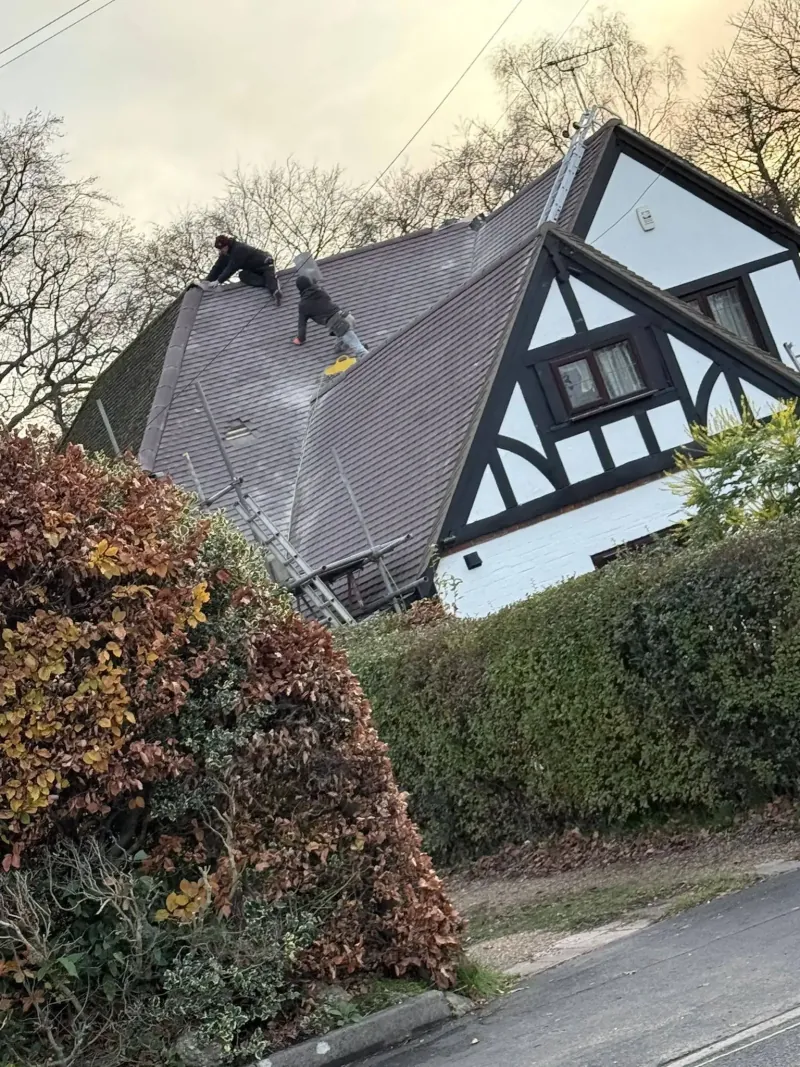
Most Frimley roofs fail in the same handful of places, for the same handful of reasons. Knowing which ones is what turns a guess into a repair that actually holds.
There is a genuine benefit to working on estate housing, and it is this: when every house on a road went up in the same eighteen months, they fail in the same order. We have often already repaired the identical fault three doors down, which means we arrive knowing where to look rather than starting from scratch.
On the interlocking concrete tiles that cover most of Frimley, the weak points are consistently the mortar-bedded ridge and the verge. Both were pointed once, when the house was built, and both have spent fifty years expanding and contracting through summer heat and winter frost. Eventually the mortar loses its grip, hairline cracks open, and water follows them.
The second recurring fault is the flashing where a rear extension or a garage roof meets the main wall. On a great many of these houses that junction was finished in sand-and-cement rather than lead, and cement simply cannot cope with two structures moving independently of each other.
None of which means we assume. Water travels along battens before it drops, so the ceiling stain is rarely below the entry point. We still inspect properly and photograph what we find — we just tend to know which part of the roof to photograph first.
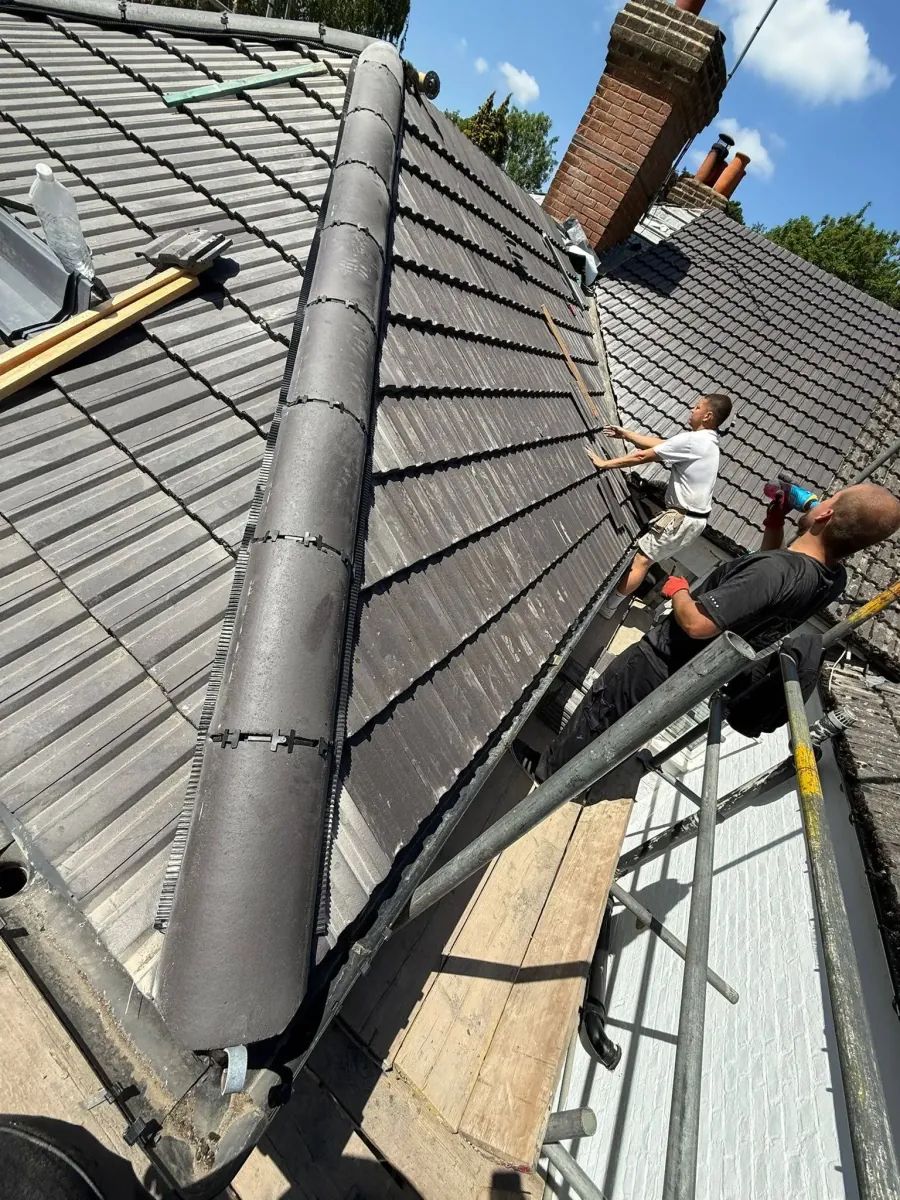
Six faults account for the vast majority of repair call-outs across GU16 and the surrounding area.
The single most common fault on Frimley estate housing. Original bedding gives up after decades of thermal movement and lets water straight in at the apex.
The gable edge takes the worst of the wind. Once mortar bedding fails there, tiles rock loose and rain drives in behind them.
Extensions and garages joined to the house with sand-and-cement rather than lead. It cracks, and water tracks down the internal wall.
The damp valley air here grows moss quickly, and clumps of it wash into valleys and gutters where they pack solid.
Concrete tiles spall and crack after enough frost cycles. One broken tile exposes felt that is often older than the household.
After a gale it is usually ridge tiles off, garage felt peeled back, or a tile through a conservatory. Made safe first, priced afterwards.
Small jobs still deserve a proper method. This is ours.
Where the water shows, when it started, and whether it only happens in wind-driven rain. That last detail rules a great deal in or out.
Roof, loft and roofline all checked. You get photographs of the genuine fault before any figure is mentioned.
One number covering access, materials and labour. If we do not think the repair will last, we say so and explain what would.
Work carried out and the finished detail photographed, because a repair at ridge height is one you will never inspect yourself.
Ring rather than emailing. We answer at any hour and can usually get a Frimley property made safe the same day.
One tile or an entire ridge line — nothing is treated as too small to do properly.
A fair amount of our Frimley repair work is correcting somebody else’s quick fix. Here is the difference.

What Frimley homeowners ask before booking a repair.
Cannot see your question? We are always happy to talk it through — there is no such thing as a silly question when it comes to your roof.
It depends on the fault and the access. Replacing a few tiles on a bungalow and re-bedding an entire ridge line on a two-storey semi are quite different jobs. The inspection is free and you get a fixed written price before we start, so there is never a vague verbal figure involved.
Very possibly, and it is a fair question on a street where the houses are identical. Where we have already done next door we have a good idea what is behind your tiles too — but we will still inspect rather than quote from memory, because roofs do get altered over the years.
If the mortar has failed once it will generally fail again, so on an exposed ridge we usually recommend converting to a mechanically fixed dry system. It costs a little more initially and removes the problem permanently rather than resetting the clock for another decade.
Not always. Genuinely minor low-level work can often be done safely from a tower. Anything above single-storey height, or needing more than a few minutes on the roof, is safer and better done from a scaffold — and we will say which before quoting.
Usually, yes. The concrete interlocking tiles used across Frimley’s estates are mostly still manufactured or have a close modern equivalent. Where a colour match is imperfect, we take sound tiles from a hidden slope for the visible elevation and put the new ones out of sight.
We stand behind our workmanship and use materials from established manufacturers. The exact cover depends on the repair and is confirmed in writing with your quote rather than promised on the doorstep.
Not quite what you were after? These are the closest services to this one.